
Tues 11 June: 9:00 AM – 5:00 PM BST Online, Zoom
University of Manchester and SHERA Research Group Conference 2024: Health and Justice approaches to Violence Against Women and Children
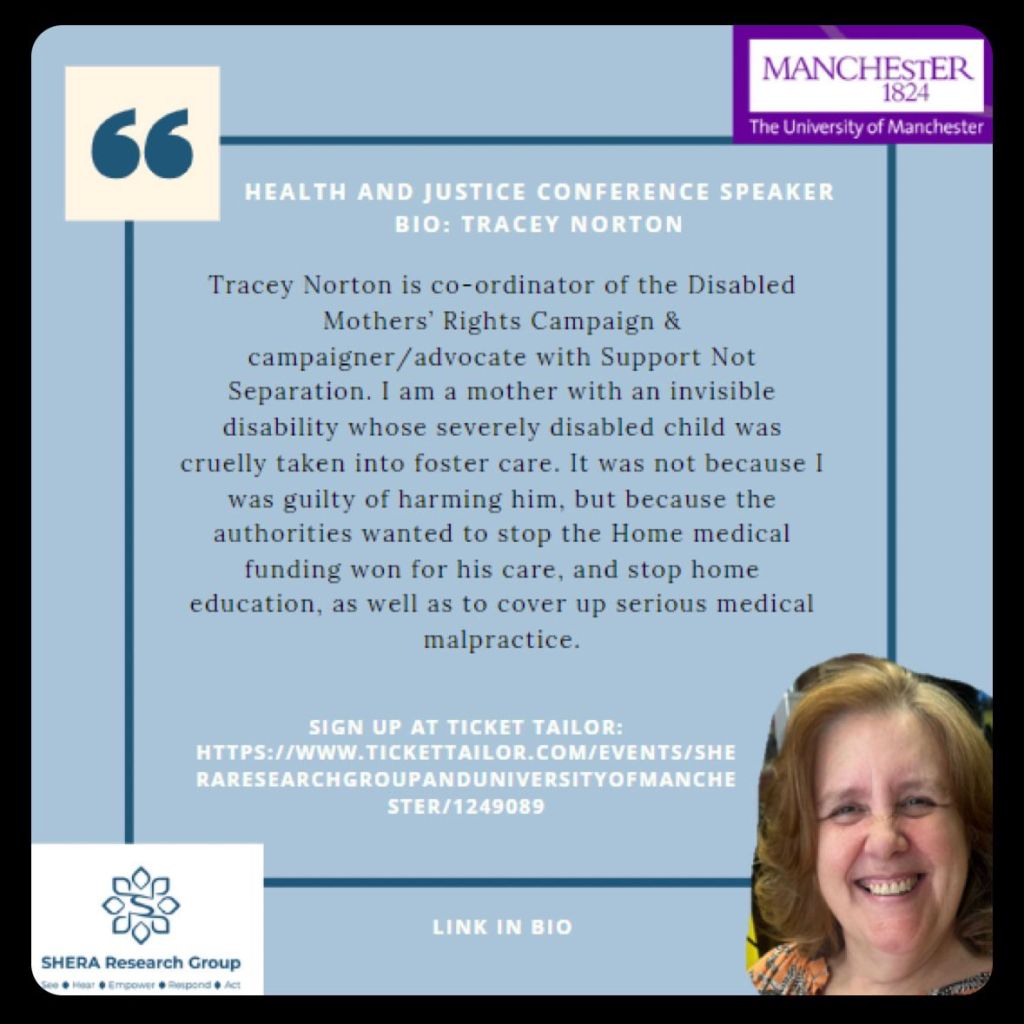
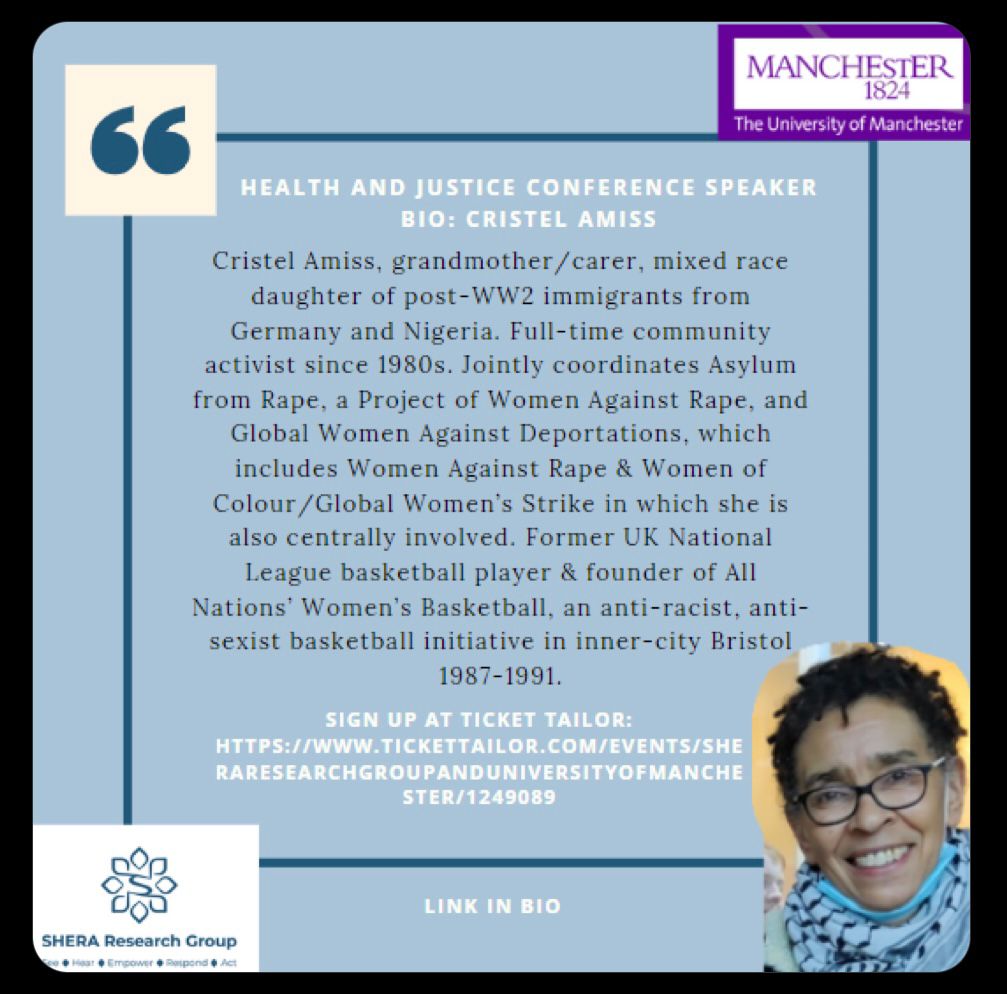
Tracey Norton of Support Not Separation and Disabled Mothers’ Rights Campaign and Cristel Amiss of Women Against Rape and Women of Colour/Global Women’s Strike will be speaking at this event about the injustices we face in family court and the damage caused by the forced separation of children from their mother or other primary carer as we fight for change.
Sign up for tickets: https://www.tickettailor.com/events/sheraresearchgroupanduniversityofmanchester/1249089
“Law is both a social determinant of health and a remedy for addressing health inequalities.” Professor Dame Hazel Genn
Violence against women and children (VAWC) is a global challenge. The health impacts of VAWC are far-reaching. Violence against women – especially intimate ‘partner’/perpetrator violence and sexual violence – is a major public health problem and a violation of human rights.
This conference will explore the intersection of VAWC, health and justice and the impacts upon women and children. Through a critical lens, we will hear from experts by experience (victim-survivors), human rights activists, professionals from NGOs, education, health, medicine, law and academia from across the globe.
Speakers will explore the intersection of health and justice, specifically in relation to the health and human rights of women and children, in the context of violence, abuse and trauma. They will discuss approaches to effective progressive safety and protection of these groups, in a culture permeated by inequalities including misogyny, racism, ageism, ableism and human rights violations. Attendees will leave with increased knowledge and skills to help support mothers/women, children, legal, health, medical and social care professionals to think critically about child protection, human rights, VAWC and the health and wellbeing of women and children.
Keynote speakers:
Professor Jane M. Spinak is the Edward Ross Aranow Clinical Professor of Law Emerita at Columbia Law School. Spinak co-founded the law school’s clinics focused on representing families and children. From 1995 to 1998, while on leave from Columbia, Spinak served as attorney-in-charge of the Juvenile Rights Division of the NYC Legal Aid Society. Spinak’s scholarship focuses on the history and effectiveness of the family court, culminating in her 2023 book, The End of Family Court: How Abolishing the Court Brings Justice to Children and Families.
Presentation Title
You Don’t Really Mean Abolishing Family Court, Do You?
Presentation Description
Abolition is a strong but often misinterpreted concept. The mindset of an abolitionist is to reimagine what is possible and to work toward that possibility without strengthening the current approach to safety and justice. In the family context, this means embracing “non-reformist reforms” that work to dismantle the current structures and institutions that control families and develop alternatives so that all families have the opportunity to flourish. Concrete steps toward abolishing family court include shifting most family supports out of the court’s sphere, vastly reducing the types and number of matters that need court intervention, and ensuring that any case that requires legal adjudication has the due process protections of a court of law. At the same time strategies must be developed that trust and respect the abilities of communities to create and sustain meaningful solutions for families.
Dr Charlotte Proudman is an award-winning family law barrister specialising in violence against women and children and the founder of Right to Equality, a non-profit promoting equality under the law. She represents survivors of rape, domestic abuse and coercive and controlling behaviour in court whilst also challenging misconceptions across the sector. She has assisted in criminalizing public sexual harassment, hymenoplasty, virginity testing, forced marriage, and child marriage. She was vital in the introduction of FGMPOs and raising the age of marriage from sixteen to eighteen.
Presentation Title
Domestic Abuse and ‘Parental Alienation’
Presentation Description
Domestic abuse allegations are often met with claims of ‘parental alienation’ by the mother against the father (the alleged abuser). This presentation will outline the harm this poses to survivors of abuse and children, drawing on first-hand experience within the family courts and relevant research. In the wider issue of violence against women and children, victim-blaming, and judicial biases, counter-allegations of ‘parental alienation’ serve as a tool of continuing abuse through proceedings, using costs and ‘experts’ as tools of abuse, and re-traumatising and discrediting the victims (all while excusing domestic abuse). There have been a number of landmark cases in the family court addressing these issues which will be integrated throughout this presentation.
Dr Adrienne Barnett is a Reader in Law at Brunel University London. Adrienne practised as a barrister for over 30 years, for 25 of which she specialised in Family Law. From 1997 she combined professional practice with academic research until moving into full time academia in January 2014. Her specialist area of research for the past 25 years has been domestic abuse and family court proceedings and, more recently, so-called parental alienation.
Presentation Title
‘Domestic abuse, parental alienation and family court proceedings: early findings from a collaborative action research project’
Presentation Description
There is growing evidence from numerous jurisdictions including the UK that in recent years claims of so-called parental alienation (PA) are frequently being used in private law family court proceedings by perpetrators to negate allegations and even findings of domestic abuse and silence victims’ and children’s voices. The charity, Rights of Women, is currently pursuing a case work project which aims to explore how PA is used in child arrangements cases where domestic abuse is an issue. In collaboration with Rights of Women, this research project, which is funded by the BA/Leverhulme Small Grants Scheme, aims to explore how PA is used in, and impacts on, child arrangements cases where domestic abuse is an issue, how family courts respond to accusations of PA, and how barriers to safeguarding victim/survivors and children can be overcome. The study adopts a collaborative action research framework involving two sets of interviews with 25 victim/survivors accused of PA in family court cases and a review of their case papers. This presentation focuses on the key themes that have emerged from the first set of interviews with victim/survivors.
Dr Elizabeth Dalgarno is the founder and director of SHERA Research Group. Elizabeth has worked in public and private health and social care for over 20 years and specialises in challenging inequalities and systemic challenges in health and social care. Her work centres always around vulnerable and/or marginalised groups. She is a staunch advocate of co-designed, developed and conducted research, where research is undertaken by and with the people it concerns, rather than ‘on’ them.
Presentation title
Court and Perpetrator Induced Trauma (CPIT): The reported health outcomes of victim-survivor women who have engaged in private law systems in England and Brazil.
Presentation Description
Gender-based violence (GBV) and Domestic Violence (DV) are prevalent globally. There are growing concerns regarding the weaponisation of the pseudo-concept ‘Parental Alienation’ (PA) and ‘alienating behaviours’ in the family courts against women. Additionally, a lack of understanding of mothers’ family court and health-related experiences indicates a need to explore this topic further. Two qualitative studies were conducted with thirteen mothers who are victims of Domestic Violence and have been accused of PA (Brazil) and 45 mothers who have been subjected to DV (England). Mothers reported a range of harmful health experiences, delineated here under the conceptual framework of Court and Perpetrator Induced Trauma (CPIT). Six themes are presented, which encapsulate a range of harmful actions, behaviours and circumstances (ABCs) that surround these mothers and their responses to these ABCs. Multiple physical health conditions were reported as associated with family court proceedings. This included maternity problems, musculoskeletal, autoimmune, and respiratory conditions and a broad range of mental health implications including suicide and other trauma responses. Human rights violations, the weaponisation of ‘Parental Alienation’ and inherently misogynistic and oppressive justice systems were also reported. Urgent measures and further research are now needed to investigate causal links between harm to health and the family courts and to strengthen human rights protection for women and child victims.
Speakers:
Hannah King has over 10 years of experience in acute midwifery, including appointment as the U.K.’s first sepsis specialist midwife. She holds a parliamentary advisory position and acts as a health consultant for international research groups, collaborating with organisations such as the White Ribbon Alliance.
Presentation Title
Providing trauma informed and culturally safe labour care for survivors of FGM/C; a toolkit
Presentation Description
Women who have survived FGM/C may only present for treatment during pregnancy and face significant obstacles during birth due to systemic racism and discrimination. These issues are compounded by the potential for retraumatisation through mechanisms of intentional and unintentional obstetric violence. A consideration of the literature examines the parallels between the experiences of those who have survived FGM/C and those with experiences of giving birth in Westernised medical settings. A toolkit is proposed with the intention of providing individualised, right-based, culturally safe and trauma-informed care to survivors of FGM/C in Western medical settings.
Cristel Amiss, is a grandmother/carer, mixed race daughter of post-WW2 immigrants from Germany and Nigeria. Full-time community activist since 1980s. Jointly coordinates Asylum from Rape, a Project of Women Against Rape, and Global Women Against Deportations, which includes Women Against Rape & Women of Colour/Global Women’s Strike in which she is also centrally involved.
Presentation Title
Exposing & campaigning against injustices and barriers faced by women of colour
Presentation Description:
Exposing the barriers and injustices faced by women of colour including: demanding justice and compensation after rape and domestic violence, and police violence/racism/sexism. Confronting institutional racism and other discrimination together with women seeking asylum from rape and other torture, migrant, refugee and immigrant women with or without papers, and how we can win.
Andreea Gruev-Vintila, HDR lecturer in social psychology at Université Paris Nanterre, conducts interdisciplinary research on the psychosocial processes involved in violence in the public and private space, the health impact of violence, as well as its social and legal sanction. She coordinated the ANR-XTREAMIS international network on xenophobia, radicalization in Europe, anti-Semitism and Islamophobia. Her work contributed to the introduction of training on coercive control at the National School of the Judiciary and to considering the criminalization of coercive control in France.
Presentation Title
How does the coercive control framework including the children and mother sabotage concept inform legal decisions? An experimental and empirical illustration from France
Presentation Description
Objective. We present an experimental and empirical illustration on how the coercive control framework, including the children and mother sabotage concept, may help increase perpetrator accountability in (French) legal decisions.
Theoretical framework. Domestic violence is a sub-category of social violence, rather than a sub-category of domestic conflict (Gruev-Vintila, 2023). It disproportionately affects women and their children (ONU, 1993). In fact, it is the most frequent form of violence against women, with implications for public health, justice, security, and inequality in this and the next generation.
However, whether it is interpreted as one or another, it depends on the interpreter’s understanding. For example, the analysis of victims/survivors’ experiences of domestic violence (Stark, 2007; Stark & Hester, 2019) relative to its social and legal sanction by third parties (social control and court decisions) reveals a gap between the victims/survivors experiences of domestic violence as “captivity” and its prevailing (mis)representation as “aggression” (Stark & Gruev-Vintila, 2023).
Drawing on the social representations theory (Moscovici, 1984) and structural social psychological taxonomies (Rouquette, 2007; Ernst-Vintila et al., 2013), we argue that the way in which the facts and evidence are understood by a third party depends on its existing social representations and positioning (Rouquette, 2009).
Therefore, rather than a simply binary perpetrator-victim/survivor relationship, we frame domestic violence as a ternary aggressor-victim/survivor-third party phenomenon (Auslander, 2019). The third party is, in the strict sense, the victim’s entourage; in the broad sense, society, with its institutions, myths and behavioral prescriptions, which, in France, set a context of a “true impunity system” for perpetrators (HCEfh, 2021), illustrated both in harming court decisions (Protéger l’enfant et al., 2022) and in the low social control (Auslander, 2019).
Sara Davison, best known as ‘The Divorce Coach’ is a multi award-winning Coach, twice best selling author and podcast host of Heartbreak to Happiness. Sara is also a global media commentator for TV and radio on breakups, divorce and domestic abuse. Following the launch of Sara’s Breakup & Divorce Coach Practitioner Accreditation Programmes in 2018, Sara founded The International Divorce Coach Centre Of Excellence which now has a coaching community of over 450 Coaches spanning 23 countries and five continents.
Presentation Title
How to Navigate Court with an abusive ex.
Presentation Description
Learn the difference between divorcing a toxic ex and a healthy partner, the pitfalls to avoid and what to expect from post separation abuse. I will also share advice on how to cope better with an abusive ex and tools that will help you dial down negative emotions and take your power back.
Paola Motosi is a Brazilian activist for women’s rights and human rights. She is a researcher, an English-Portuguese translator and interpreter and a specialist in human rights and intersectionality. Paola advocates against domestic violence and supports feminist collectives and organizations by helping to provide access for survivors of domestic violence to international mechanisms for the protection of human rights. Her main goal is to raise international awareness about human rights violations against domestic violence survivors.
Presentation Title
Discriminatory policies and practices against women in Brazil
Presentation Description
Brazilian women face many adversities including high rates of domestic violence, institutional violence and femicide. While there is a global struggle to ban the pseudo concept of parental alienation, which is being described by mechanisms for the protection of human rights as a tool for the perpetuation of violence against women and children, the Brazilian State has institutionalized the concept of parental alienation through its Parental Alienation Law since 2010.
Such situation has called the attention of researchers in Brazil and also other countries, such as the UK and Canada. In order to understand the impacts of legitimizing a dangerous concept that is even forbidden in some countries, as well as condemned by the UN and OAS, many studies were conducted. As expected, the results presented so far, pointed to serious problems concerning the implementation of such policy in the country, problems that include institutional discrimination and the perpetuation of violence that led to further risks and health issues to survivors.
Tracey Norton is co-ordinator of the Disabled Mothers’ Rights Campaign & campaigner/advocate with Support Not Separation. I am a mother with an invisible disability whose severely disabled child was cruelly taken into foster care. It was not because I was guilty of harming him, but because the authorities wanted to stop the Home medical funding won for his care, and stop home education, as well as to cover up serious medical malpractice.
Presentation Title
Challenging Discrimination Against Mothers in Family Courts
Presentation Description
Bringing together women with disabilities, single mothers, women of colour, asylum seekers, and rape survivors to stop our children being adopted, taken into care or forced into contact or residence with violent fathers. Challenging the downgrading of the mother/child bond and discriminatory assumptions that mothers’ disabilities are harmful to our children; insisting on the help and support we’re entitled to. Campaigning for the courts to be open and against the rampant privatized children’s “care” industry.
Rachel Horman-Brown is the head of the family department at Watson Ramsbottom solicitors and specializes in children cases concerning coercive control and stalking. Rachel is also the Chair of Paladin – the National Stalking Advocacy Service. Rachel’s work has been recognised with many national awards, including the 2012 Legal Aid Lawyer of the Year Award and 2014 Jordan’s Family Partner of the Year Award. In 2016 Rachel was highly commended as Woman Lawyer of the Year at the National Law Society Excellence Award and she won Eva Women in Business Award and in 2019.
Presentation Title
Coercive Control and the family Courts
Presentation Description
An overview of how the family courts have dealt with allegations of coercive control and what needs to improve
Dr Rima Hussein is Assistant Professor and co-lead for the gendered, violence and abuse (GVA) interdisciplinary research theme at Northumbria University. She specialises in social justice with research on inclusion, GVA, and family law courts.
“Being silenced feels like yet another form of institutional betrayal”
This presentation will reflect on a CAPE funded project with survivors of domestic abuse, the aim of which was to co-produce self-help Vlogs for survivors who are starting their family court process. During the process several survivors wanted to share tacit knowledge from their own experiences but were impeded by court rules, with their image and voices needing to be altered and masked. This presentation will discuss some of the legal challenges and impact of the strict family court reporting rules silencing survivors and their lived experience. I will then consider options for how survivor stories could be shared for change, given these barriers.
Dr Jessica Taylor and Jaimi Shrive are the founders and directors of Victim Focus. VictimFocus provides critical thinking, evidence based practice, accessible information, affordable educational resources and challenging ways of approaching victim support services through a trauma-informed lens. Jessica is the author of ’Why Women Are Blamed For Everything’ ‘Sexy But Psycho’ and her latest book ‘Underclass: a memoir’. Jessica’s books are Sunday Times, New York Times and Amazon best sellers and have been read by tens of thousands of people globally. Jaimi Shrive is a doctoral researcher in politics and criminal justice and human rights activist. These formidable women, together have produced many free resources for victim-survivors and professionals.
Presentation details:
Jess and Jaimi will discuss the ITIM, their current work and the importance of trauma-informed frameworks and Jessica’s new book ‘Underclass: a memoir’. ITIM is described as:
“A non-diagnostic, trauma-informed guide to emotion, thought, and behaviour.”
This must-have manual presents a trauma-informed, non-diagnostic alternative to other manuals of mental health issues and psychiatric disorders. Rather than lists of disorders and medicalised symptoms, this extensive manual provides information about hundreds of trauma responses, emotions, thoughts, behaviours and experiences that have previously been categorised as illnesses and disorders.
This world-first trauma-informed manual equips progressive professionals with evidence-based, anti-oppressive, anti-blaming and non-diagnostic information about a wide range of human emotion, thought, and behaviour. Building on the quickly growing consensus that trauma-informed, anti-oppressive practice is vital to the way we understand society, ourselves, and our clients; this book provides the first comprehensive alternative to diagnostic manuals.
ITIM and Underclass are available to purchase via the Victim Focus website and Amazon:
Indicative Trauma Impact Manual 2023 (ITIM) – victimfocus resources (victimfocus-resources.com)
Underclass: A Memoir – victimfocus resources (victimfocus-resources.com)
Expert by Experience (victim-survivor) panel
We will hear insights from anonymous victims-survivors who have engaged in the private law family court system
 Support Not Separation