Anne Neale from Support not Separation was invited to speak at Public Policy Exchange’s policy discussion webinar, Improving Foster Care: Reforming the sector and improving outcomes for children under a new Labour government, which took place on Tuesday, 11 February 2025 (09:30-13:00).
Our title “Recognition of and support for the mother/child bond and mothers’ caring work as central to child welfare”.
Please see the speech below.
Support Not Separation Coalition is coordinated by LAW and includes organisations of single mothers, women of colour and asylum seekers/refugees, women with disabilities, rape survivors, breastfeeding advocates, kinship carers, psychotherapists, men and social workers, committed to defending mothers and children against unwarranted separation and the devaluing of the mother-child relationship. We work closely with Give Us Back Our Children in the US which is part of SNS and with mothers in other countries who share our aims.
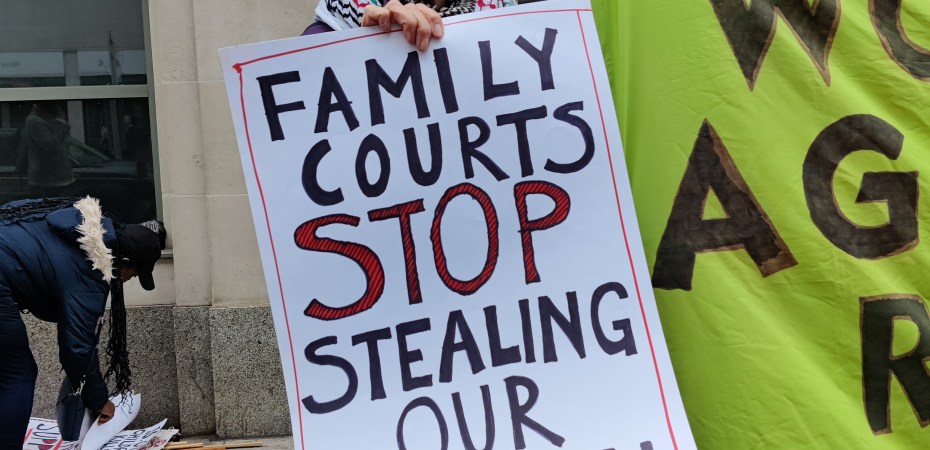
In 2017, LAW published a Dossier Suffer the Little Children & their Mothers and in the same year we started having monthly pickets outside the family court in central London (and a twitter storm at the same time) – we’re coming up to our 8 year anniversary on 5 March. Our picket this month celebrated the victory that courts in England & Wales are now open to journalists & legal bloggers – ending the secrecy of the family courts has been one of our central demands and it’s a massive victory for ETC
We hold monthly collective self-help meetings at the Crossroads Women’s Centre where we’re based, & also online where mothers exchange tactics drawing on their own experiences and the experience of the organisations based at the Centre, esp WAR, WinVisible, and WOC in GWS. We’ve a blog and an online self help guide which we always refer women to.
When we put together a snapshot of 250 mothers with 446 children we worked with this is what we found and it really exposes what’s going on in the family courts, which is crucial to understanding why so many children are in the care system.
94% were single mothers, mostly on low incomes; 83% had suffered domestic violence; 42% had mental health issues 40% were women of colour and/or immigrant; 17% had a physical disability, which was used against them.
Nearly all were fighting over contact with their children They were trying to stop violent fathers having unsafe unsupervised contact, or trying to re-establish contact with children who had been given to the father, or were in foster care or had been adopted as a result of hostile social workers and judges.
Over half the mothers had had their children removed, including 10% whose children had been adopted without their consent. This shocking figure gives lie to the idea that forced adoptions are historic, they are in fact a present-day policy of punishment and social engineering.
Mothers fighting to protect children face a hostile environment in the child welfare system and in family courts in which the misogynist fathers’ lobby is embedded – they’ve heavily influenced social workers and CAFCASS, the body supposed to promote children’s welfare, and are good friends with the President of the Family Division.
Reforming children’s social care has to begin by recognising the importance of mothers in children’s lives – after all we carry them for 9 months, give birth and in the majority of cases are their primary carers for the whole of their childhood. But social workers, psychologists and other professionals increasingly favour fathers as the mother /child bond and the importance of mothers in children’s lives is dismissed, ignored or devalued. They never take into account that children are often more traumatised by being taken from a mother who maybe struggles for example with mental health or with a physical disability, or with a drug or alcohol problem and are forced to live with strangers than if they stayed with their mother, or were supported to live with grandparents or other family members.
Kinship carers are also greatly undervalued and we recognise the crucial work being done by the Scottish Kinship Care Alliance who are mostly grandmothers raising their grandchildren. They have fought long and hard for kinship carers to get the same financial and other support that foster carers get, and in some parts of Scotland they have succeeded. But even when they succeed, the system discriminates against those who are on benefits – who get some of the money for kinship care deducted from their benefits. They have also fought for recognition of “voluntary” kinship carers who take on their grandchildren without them ever having to go into the family court system but then don’t get any financial support at all. This is an abuse by the state which only gives financial support after causing trauma to children by taking them into care often as newborns, and eventually giving them back to kinship carers, but are then traumatised by that early separation from their primary carer. Grandmothers or family members who step in immediately get much less financial and other support than other kinship carers or foster carers and that has to change.
There are over 83,630 Children in “care” in England with an estimated 107,043 children in care across the UK. which includes a disproportionate number of children of colour (including those taken because their immigrant parents have no recourse to public funds) and disabled children.
Recent research shows that as many as one in four children in England need social care services before they turn 18. Over 4.3 million children live in poverty and that number rises year on year, made worse by the two-child benefit cap, the bedroom tax and the overall benefit cap. The poorest families have an average income 57% below the poverty line, with this gap increasing by almost two-thirds over the past 25 years. Families cannot afford to meet their most basic physical needs to stay housed, clothed and fed and increasing numbers are forced to use food banks. Child “neglect” ie poverty is the single biggest target of the corporate parent, together with domestic violence, which is deeply connected to poverty which stops women escaping. 10,000 children entered the care system for reasons linked to poverty in the five-year period from 2015-2020 according to a Lancet peer-reviewed study b. 11.4% increase in households with children who were either threatened with homelessness or already homeless (2022-23 compared to 2021-22).
Research suggests that disabled children are more likely to be “looked after” than non-disabled children: 5.7% of disabled children in the general population are looked after whilst this applies to only 0.6% of the child population as a whole (Poverty & Social Exclusion in the UK, Gordon et al, 2000). Other studies also find that disabled children are likely to stay in care for longer (Permanence and Stability for Looked After Children Cleaver, 2000). And disabled children placed in institutions are five times more likely to be abused Disabled Mothers’ Rights Campaign and Support Not Separation worked with Channel 5 on its national news programme broadcast in January 2023. Their shocking findings were that parents with a learning disability are 54 times more likely to have their children taken into care.
At the heart of this is that disabled children (and their mums) are less likely to receive the correct support than their peers simply because Section 17 support in The Children’s Act is not mandatory. Disabled children often have disabled mothers and due to discrimination and as a way of saving money social workers often claim that the mothers are “projecting” their own disabilities onto their children, in other words, the child’s needs are not genuine. This leads to child protection and/or child removal rather than assessing a child’s needs.
The disastrous outcomes for care leavers are widely known yet rarely figure in discussions about what can be done: they are over ten times more likely than their peers to be not in education, employment or training (NEET) by 21; when they leave care, 50% will be in the criminal justice system by age 21; 25% will end up in prison; 50% have mental distress; 70% die prematurely and are 20 times more likely to die by age 25. This shows what a terrible job the corporate parent does and makes clear that the best way to improve the well-being of children in care is not to take them into care in the first place.
Despite this appalling record, rather than prioritise support to families under Section 17 of the Children Act, that support has declined significantly. Parliament was told recently that every year local authority budgets allocated to S17 of the Children Act (to support families) have been reduced by 50% whilst budgets for S47 (for child protection and removal) have more than doubled every year. This means that very often when mothers go to Children’s services to ask for the support they are entitled to, including because they’re victims of domestic violence, or need support for disabled children, they are told no help is available for cost reasons. Mothers are too often blamed for not coping with their disabled child’s needs as way of cutting money spent on supporting families. Instead, they are pushed into child protection where they face intervention and investigation by social workers. In fact “child protection” investigations have increased by 127% in the past 11 years, but the number which did not result in a “child protection plan” (i.e. proved to be unwarranted) went up by 211% over the same period. This is the link needlessly taken
It is urgent for S17 spending to be put on the same footing as S47 spending – i.e. made a statutory duty instead of optional and for spending on support to be prioritised overspending on child removal. Social work assessments under S17 MUST BE DONE SEPARATELY from assessments under S47 (child protection) under the current single assessment.
The increasing privatisation of children’s services has led to fostering and adoption becoming a highly profitable industry worth millions, which depends on a continual “supply” of children. A recent report found that the largest 20 independent providers of children’s social care brought in profits of more than £300 million in 2022. This is obscene profiteering from children and mothers’ misery. Rather than capping profits, there should be NO run for-profit organisations either in children’s homes, residential schools or foster care. In Scotland for-profit provision is already illegal, and Wales are now proposing the same. The money saved should be allocated to Section 17 support.
Some local authorities are taking a different approach with good results. In the 1970s Andy Bilson reduced the numbers of children going into care by 70% as a result of giving social workers in Fife the same budget for supporting children at home as they got for taking children into care. And recently Neath Port Talbot had one of the highest numbers of children going into care in Wales. But by supporting families in the community it has halved the number of children in care and now has one of the lowest rates in Wales, despite contacts to the team increasing by 53%. Helping children stay with their mothers is a priority in Neath Port Talbot and should provide a model of good practice for others to follow.
The current Children’s Wellbeing and Schools Bill going through Parliament assumes that children’s wellbeing will be improved by more professionals in their lives, more monitoring by more agencies and more foster carers. This is absolutely not true. It also proposes a huge extension of state control via what it calls a “consistent identifier”. We note that this was proposed in Scotland in 2016, widely objected to and challenged up to the Supreme Court which ruled it as illegal because it contravened the right to family life under Article 8 of the Human Rights Convention. So that should be a non-starter right there!
We have made a submission to the Committee considering the Bill on other proposals which we oppose – and that will be available shortly on our blog.
But we do want to comment on the proposal to limit a parent’s power to home educate and registration of children not in school. A study found that the risk of abuse for home schooled children is half or less than at school
Most home educated children are removed from school by their families because of the current broken Special Educational Needs (SEND) system and the Bill does not address any of the problems with SEND. Children with disabilities and/or SEND needs are automatically known to Children’s Services because they need to be involved in care or EHCP plans. Penalising them by refusing to allow them to be home educated is discriminatory and unfair.
This proposal may have been fuelled by the Sara Sharif’s case because she was removed from school and home educated. However, she was known to social services and the school’s concerns were reported to them but no investigation happened and the case was closed. The issue is not home schooling but the fact that Children’s Services are very reluctant to challenge violent fathers and that a family court judge sent her to live with her father, whose long history of domestic and physical violence was well known.
Our proposals for improving Children’s Social Care
Recognise the bond between mother and child as the child’s first and most crucial relationship. Supporting mothers is the best way to ensure children’s health and well-being.
Prioritise implementing financial support under Section 17 of the Children Act 1989 with a view to keeping families together.
Implement Care Act support for disabled mothers who have caring responsibilities for a child.
Address child poverty by addressing mothers’ poverty, especially single and/or disabled mothers, often of colour, who are among the poorest and most likely to be targeted for intervention by children’s social care.
Stop taking children on the basis of “neglect” conflated with poverty There is already legislation in California forbidding poverty being used as neglect to take children, and a Special Committee in Philadelphia proposes that neglect should be removed from the law.[vi]
Stop taking children into care because of domestic violence and end the use of predicted “future emotional harm” which enables social workers prejudices and manipulation to justify taking children from loving mums.
Victims of domestic violence must be helped to escape and live independently from violent men. The “presumption of contact” must end so violent fathers are not allowed unsupervised contact or residence of children.
End forced adoptions
Recognise that the harm caused to children by separation from mother and siblings, and by being uprooted from all that is familiar, invariably outweighs the difficulties children may face within their families, the majority of which could be overcome with proper financial and practical support.
Provide the support families ask for, rather than what social workers decide is appropriate, which invariably means intrusive and degrading monitoring and prejudicial judgements. Strengthen communities by providing cash and services, not by adding layers of professionals whose priority is intervention, not support.
Remove privatisation from children’s services to end the profit motive
Give mothers and other primary carers a Care Income so that the work mothers do caring for children is financially recognised and no mother can be accused of neglect because she is poor. This would protect mothers and children from professionals abusing their powers and acting as if they know best, as if the children belong to the state and not to their families. Foster carers receive between £400 and £600 a week – why not mothers whose caring work would prevent the institutionalisation of children and avoid lifelong trauma?
Reinstate legal aid for all family law cases.
 Support Not Separation