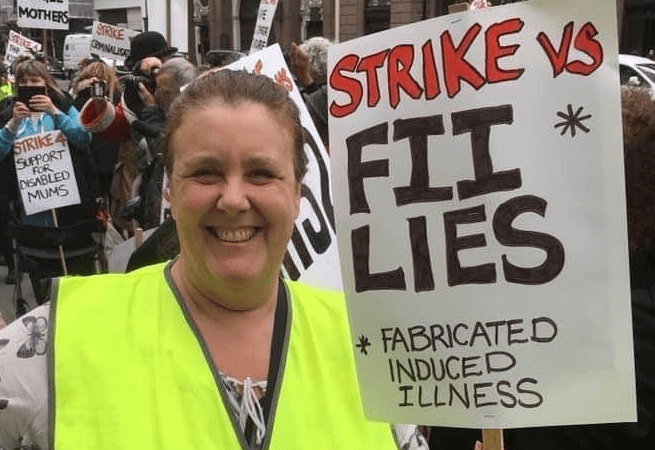
In November 2023, Tracey Norton (SNS & Disabled Mothers’ Rights Campaign) worked with Channel 5 and two other mothers, speaking out against the injustice and heart break of losing a child to false accusations of Fabricated Induced Illness (FII), and the life long trauma it leaves families with. Despite being de-bunked by academics & professionals such as Professor Andy Bilson, Professor Luke Clements, Dr Fiona Gullon-Scott and Cathie Long, there is considerable evidence to suggest that increasing numbers of parents are being accused of fabricating or actually inducing their child’s illness. However, FII is a term made up by professionals with no actual diagnosis and used primarily against mothers seeking support or medical care for their children often after they have complained against doctors or teachers. We’re joining calls for the immediate withdrawal of the FII label and associated guidance – government must act now!
Some of society’s most vulnerable are being torn from their families by officials who claim their parents are fabricating illness
Emily Dugan SUNDAY TIMES 19 July 2025
Elly Chapple was used to heated battles with social services and clinicians when she pushed to get the best care for her daughter, Ella. A rare genetic condition, combined with being deaf and blind, had left Ella with multiple complex disabilities and she needed extensive help.
But Chapple had no idea that the way she fought her daughter’s corner might contribute to a child protection intervention that would risk losing her for ever.
Chapple’s advocacy for Ella’s needs, along with unfounded allegations that she had overmedicated her, raised red flags because of a rare form of child abuse known as fabricated or induced illness (FII), where parents exaggerate or cause their children’s symptoms.
While social services and the family courts investigated the allegations, Chapple was forced to live apart from her daughter for eight months. “Going to ask for help turned into our worst nightmare,” Chapple said. “We were forcibly split as a family.” Last year Ella won a civil case that found the council had acted unlawfully and breached her human rights.
An investigation by The Sunday Times has found that Chapple is one of hundreds of parents, mostly mothers, who are being falsely accused of fabricating their child’s illness, facing allegations of abuse, when they seek medical or social care for their children.
They are often threatened with losing access to their children and wait months to have their name cleared. In the worst cases the child has become more ill or even died.
We examined a number of cases. Many could not be reported, often because parents were scared of speaking out for fear that it would lead to more action against them or because they are bound by reporting restrictions of court proceedings.
Among the cases were:
• An assistant head teacher who struggled to find work after he and his wife were investigated for FII when pushing for treatment for their child’s initially unexplained health condition. He had to declare that he had been subject to safeguarding concerns.
• A nurse initially accused of FII who lost regular shift work because of her safeguarding history, despite her child having since been diagnosed with a rare condition and no further action taken.
Parents arrested for suspected FII while their infant was critically ill in hospital and prevented from cuddling them while waiting months for the family court to conclude fact-finding.
What used to be called Munchausen’s syndrome by proxy, and is now known as factitious disorder imposed on another, is captured under the umbrella of FII. While dangerous, it is acknowledged by clinicians to be extremely rare. But high-profile cases such as that of Gypsy-Rose Blanchard, who killed her mother in America after years of being abused and forced to use a wheelchair and feeding tube she did not need, have heightened fear of it.
Experts believe the number of families accused of FII is rising as a result of guidelines issued by the Royal College of Paediatrics and Child Health which give 20 “alerting signs to possible FII” that include understandable behaviour from concerned parents.
The guidelines were expanded in 2021 to include seeking numerous medical opinions, making complaints and not accepting reassurance while demanding more tests. Researchers say this is resulting in hundreds of anxious parents who question their children’s treatment being subjected to child protection investigations.
Many of the parents affected admit that they could be perceived as “difficult” or having acted angrily with those in authority, but said the reason was because they could not obtain answers or help.
New research shows that FII has been substantiated only in four serious case reviews since 2010 and caused no deaths. Yet a snapshot survey by the University of Leeds in 2023 found that almost 400 families reported having been accused of FII.
Local authorities do not collect data on the number of investigations for FII but at least 74 per cent of English children’s services authorities have pursued FII allegations, according to the Leeds research.
The advice on looking out for FII is in stark contrast to the recommendations of Martha’s Rule, which allows concerned relatives to request an urgent second opinion on critical care. Since its introduction last year, the practice has resulted in 129 patients in England receiving lifesaving medical intervention. Yet clinicians and social workers are told that parents seeking a number of medical opinions is a warning sign for FII, which can trigger a child protection intervention.
‘I was ripped from her life for months’
In April 2020, as Ella was discharged from intensive care following a nearly fatal bout of pneumonia, everything started to unravel.
A social worker phoned and asked her mother to find a room to speak alone in. “I thought, ‘Oh God, something really bad is about to happen,’” Elly Chapple said.
The council were starting urgent child protection proceedings over concerns about Ella and she was told that she could not return home with her daughter. She went into shock. “I couldn’t stop crying. I was dry retching … I’d been with her every day for six weeks to get her well from near death. And then suddenly I was just ripped out of her life.”
Ella has a rare genetic condition called WAGR syndrome, which caused developmental delays, problems with sight and a kidney tumour when she was younger. She struggles to communicate, needs help to walk and sometimes uses a wheelchair. Her complex needs meant she was constantly interacting with social services.
Hospital staff had initially raised concerns that the Chapples had not taken Ella to A&E sooner. A child protection meeting had been held and it was agreed that further intervention was not needed, because Ella had deteriorated rapidly. It was the start of the pandemic and it was understood that people were frightened to attend hospital at the time.
But when further unsubstantiated allegations about Chapple were raised with social services, including that she overmedicated Ella, there was an abrupt U-turn. Care proceedings were issued, with a view to removing Ella from the family.
On the day Ella came home, Chapple was only allowed to grab a bag before going to live at her parents’ house with her two younger children. Her husband, James, looked after Ella in their home with carers.
It was more than two weeks before Chapple was allowed to have even brief, supervised visits with her daughter in her own home.
It would be another eight months before they could live together permanently again.
‘Unqualified’ helpers imposed
The impact on Ella was profound. Chapple, 49, had given up her career as a businesswoman to look after Ella and their two younger children at their home in Northumberland. She was an outspoken advocate for her daughter and disability rights, and recorded a Ted talk celebrating difference.
Chapple said it later became clear that the local authority saw her as a prolific complainer and a problem. “They were very anti-me and very much, ‘Just don’t go near her, she’s a nightmare.’”
Ella’s care plan specified two-to-one support from a team of specialist helpers who understood the particular needs of deafblind children. The council gave them a budget of more than £100,000 to run this independently.
When Chapple was separated from Ella, the local authority put in a new team of agency staff, who she says lacked the training or expertise to look after Ella, including not knowing how to use the specialist deafblind appropriate sign language. She claims Ella’s condition deteriorated rapidly.
Over the summer, the local authority attempted to move Ella to a residential home against her parents’ wishes. On a visit to it, Ella became distressed and communicated “Mummy”.
By August, Ella’s headbanging had become so pronounced that she had two black eyes and severe bruising. After the court ordered the council to look into care options for Ella at home, the local authority dropped its attempts to remove Ella from her family, acknowledging the legal threshold was not met.
At the end of October, the family court discharged an interim care order that was preventing Chapple from living with her daughter. She was able to return home in December once the judge formally granted permission to the council to withdraw care proceedings.
‘It could happen to anyone — it’s like a tsunami’
Chapple says the whole family is still scarred from the experience. “It’s utterly traumatising. I know that they’re terrified of missing a case. I know that they’re under inordinate pressure. And I know that there are really good people in social services because I’ve met them … But this is causing life-changing harm.”
She said of the child protection intervention: “This could happen to anyone. And it can happen at speed … with such velocity and force. It’s like a tsunami, you don’t stand a chance. We were a very strong family unit with a very strong support network. How on earth would a mum on her own get through week one? I don’t know. It took everything we had to withstand it.”
James, 50, lost his property business while he was trying to fight to get his family back together. He said: “I’m terribly sorry to say I feel that they would be capable of doing exactly the same thing against somebody else. ”
Last year Chapple was given a £50,000 payout from Northumberland county council for breaching her human rights by bringing unnecessary and damaging care proceedings. But many families do not even receive an apology.
A Northumberland county council spokesman said: “We reached agreement on this case in September 2024. We would not wish to comment further.”
‘Ignoring evidence and empathy’
The number of families falsely accused of FII has become so high that experts met at the dispute resolution organisation St George’s House, in the grounds of Windsor Castle, this year to find solutions.
In a final report, they recommended that national guidance be set by the government to avoid a moral panic and that training was needed to emphasise how rare the phenomenon is.
It said: “False allegations of FII are a constant risk to the public, to families and especially to vulnerable children who are consistently failed by aggressive safeguarding responses that ignore evidence and empathy.”
Many parents accused are seeking a diagnosis for autism or other neurodevelopmental conditions and themselves are neurodiverse, affecting how they communicate with services. Parents with autism are three times more likely to be accused of FII than those without the condition, according to research by the Association of Directors of Adult Social Services last year. Its survey of parents with autistic children found one in six had been accused of fabricating illness.
More than half of parents investigated for FII had first made a complaint against the school attended by their children, social services or health services, the Leeds University study found. Luke Clements, co-author of the report, said: “This idea of retaliation, of victimisation is very strong.”
Even when allegations are dropped quickly, the impact of a child protection investigation can be devastating. Teachers, clinicians and other parents in positions of responsibility have to declare that they have had safeguarding concerns made against them.
Clements said: “The thing that hits you like a freight train when you get those survey responses is the trauma that families experience. Some of them have spent periods in prison before being vindicated. Many of them have lost their jobs. Many of them will never ever have anything to do with social services or health services again.”
Dr Luke Geoghegan, head of policy and research at the British Association of Social Workers, said: “This feels like it could be a moral panic. The number [of families accused] does seem to be very high, which makes me suspicious.”
A paper recently published in The British Journal of Social Work suggests the risk of FII may be overstated.
Andy Bilson, emeritus professor of social work at the University of Central Lancashire, said: “Although a range of guidance and journal papers suggest that FII is associated with a high risk of mortality or serious harm in as many as 10 per cent of cases, analysis of serious case reviews in England from 2010 to 2021 found no child deaths resulting from FII and only four cases of serious harm, all linked to earlier concerns about overmedicalisation or clinical error.”
Bilson believes official guidance “pathologises disagreement” by parents. In another paper next month he will argue that the term FII should “be assigned to the history books” because it has become so broad that it captures parents who are nothing more than overly anxious.
An Royal College of Paediatrics and Child Health spokesman said that when its guidance was last updated in 2021 it was conducted “via a multidisciplinary expert working group” which considered the published evidence available at the time, “alongside extensive consultation with relevant professionals”. They said the guidance was due for an update and that “any new evidence will be considered”. The college is also “actively exploring options to ensure that the planned update to the guidance sufficiently captures a multidisciplinary approach”.
Melody begged us to ease her pain and we couldn’t
Karina Driscoll’s daughter Melody spent much of her short life in hospital thanks to a rare life-limiting condition called Rett syndrome. It was a lot for any parent to contend with, but in the final year of her daughter’s life Driscoll also faced the constant threat of having her taken into care.
Melody was 11 when she died of acute pancreatitis relating to her condition and complications from an operation. Months earlier, Driscoll was accused of FII by a clinician at King’s College Hospital in southeast London, who claimed there was no evidence that she needed some of the medication she had been prescribed.
Once the investigation started, Driscoll was unable to act when she believed she saw her daughter in pain. She said she was told if she did not agree to the removal of some of her medication Melody could be taken away.
Driscoll had been advised by doctors to administer boosts to her pain relief when she believed her daughter was in pain. But now she was unable to act.
“Even though she couldn’t talk, Melody communicated with her eyes and she would beg us to help her. We just couldn’t. We weren’t allowed. And she didn’t understand that. That was the worst thing ever and I still have flashbacks of that to this day. It haunts me.”
The investigation also meant she and Melody’s stepfather only had supervised access. “None of the curtains were allowed to be closed,” she said. “They had to watch me at all times.”
She still believes that the withdrawal of some of Melody’s treatment while the investigation took place was a factor in her deterioration. An expert for the family argued this at her inquest but a coroner ruled that her care was appropriate.
The inquest heard that a doctor had emailed another staff member to say they “should not pander to this family”. Driscoll said: “We were classed as problem parents because my daughter didn’t have a voice. I spoke for her. And this doctor was very much of the view that — she even said it to us — ‘I am the one with the PhD, you’re just the parent’.”
King’s College Hospital NHS Foundation Trust said: “All clinicians have a responsibility to address safeguarding concerns when they suspect a child is at risk. As with concerns about any form of abuse or neglect, when fabricated or induced illness [FII] is suspected, our teams follow the agreed protocol and liaise with the relevant external agencies. Failure to address safeguarding concerns would be a breach of their duty of care.”
Since her daughter’s death, Driscoll has been plagued by fears that the younger of her other five children will be taken away. When the school wanted one of them to be assessed for additional needs, she was scared to sign the paperwork in case she was accused again.
Driscoll said: “Even though I was proven innocent, it’s still on my records that I’ve been accused of it. So I still get looked at differently”.
A government spokesperson said: “These types of cases are incredibly distressing. While fabricated or induced illness is a rare form of abuse, it is extremely serious, and it is right that it is investigated sensitively. Professionals are trained to take appropriate steps to safeguard children, supported by ongoing professional development and government guidance that we keep under review.”
 Support Not Separation