The government has issued a consultation on major changes it wants to make to children’s social care and child protection, including Working Together and new Multi-Agency Child Protection Teams. The consultation closes on 4 September and is open to all who want to comment. See here.
Together with the Disabled Mothers’ Rights Campaign we gave evidence to the consultation – see below.
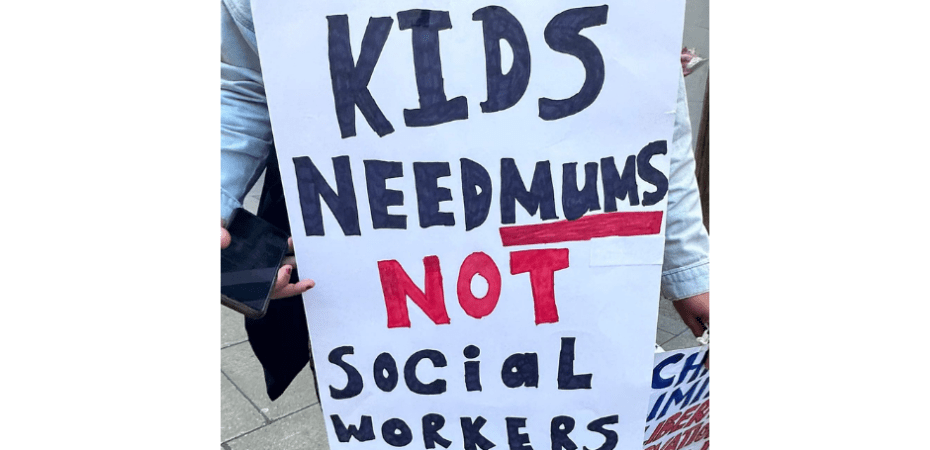
We are strongly opposed to most of the recommendations, especially because they do not address the fundamental issues of why mothers who ask for support are then monitored in punitive ways by social workers and children pushed into child protection/taken into care/forcibly adopted. There is no recognition of the mother/child bond and the lifelong trauma of separation. Social workers powers would increase under these proposals with even less, if any, independent scrutiny.
We are strongly opposed to any extension of the multi-agency child-protection schemes (MASH) which intensify investigations against mothers. See research by Dr Andy Bilson showing that “when a MASH is introduced, more children are investigated… However, most of these extra investigations do not result in child protection plans, and there is no evidence that MASHs reduce serious harm or child deaths.”We are strongly opposed to most of the recommendations, including because they do not address the fundamental issues of why so many children who need support are instead pushed into child protection/taken into care/forcibly adopted. There is no recognition of the crucial importance of the mother/child bond and the lifelong trauma that separation from mothers/primary carers causes children.
We do agree that all targeted family help should be provided under S17 of the Children Act, which must be put on a statutory footing with equal if not greater financial funding than Section 47.
We gave evidence to the consultation which has a series of drop-down questions as well as limited space for comments, see below.
1. Do you agree that these proposals will strengthen the voice of children and families, including those who are under-represented or marginalised, in multi-agency safeguarding arrangements.
We strongly disagree
2. Is there anything else you would like to comment on in relation to child and family voice and how this is included or represented in the statutory framework for help, support and protection (Working Together and the National Framework)?
In order to genuinely listen to “child and family” voice, the WTNF must recognise:
- the importance of the mother/child bond and ensure that children are always supported to live safely in their immediate or extended family
- the lifelong trauma separation causes;
- the sexism, racism, classism and disability discrimination which make families vulnerable to state interference, where the focus is on punitive measures such as “child protection” and removal rather than family support.
Social workers retain all the power in the “child protection” system and are very rarely held to account for the often terrible consequences of their decisions for children and families. So called “risk aversion” (the worry that a child will be hurt unless removed) has become an excuse for the most scandalous abuse of power against mothers and children, followed by a cover up of any subsequent abuse of children while in ‘care’. The WTNF does not explain how its recommendations will work in practice.
Section 2: Multi-agency safeguarding arrangements (MASA)
6. Do you agree that this approach and proportionate LADO involvement would improve consistency and outcomes for children?
We strongly disagree
7. Is there anything else you would like to comment on in relation to MASAs or the role of the LADO?
Mothers repeatedly report going to Children’s Services for help, finding none was available and then being fast-tracked to “child protection”. This conflating of “child protection” with “child in need” will lead to further harm/trauma and more child removals. Mothers and families under “child protection” are put under intense scrutiny; social workers never recognise how stressful this is; and challenging a social worker’s report or proposals leads to allegations of being “difficult” which is then used as an excuse to remove children. Social workers act as a law unto themselves; there is no accountability while cases are proceeding or afterwards. Proposing the same lead social worker who investigates a family to chair CP conferences
removes any oversight or independent scrutiny. The suggestion that local areas may choose to have an individual or an externally commissioned group delivering their scrutiny is not independent and gives rise to abuse of the system.
Section 3: Help and Support
8 Do you agree that Targeted Early Help should be removed and all Family Help support and services should be provided under section 17?
We Agree
9. Please outline the reason for your answer to question 8.
Section 17 must be put on a statutory footing with equal if not greater financial funding than Section 47. Resources available under Section 17 must be prioritised with a view to keeping families together, supporting mothers and kinship carers (mainly grandmothers) to get the same financial support as
foster carers. With councils paying £10,000 a week for some care placements, Rachael Wardell ADCS president said “one of the moral dichotomies in policy” was the acceptance that councils fund placements for children in “care” but that there was “no clear offer of financial support to birth families to
enable children to remain in the family home”. This is the crucial issue. Local authority spending on private residential care placements for children has skyrocketed with an increase of £400m to £1.8bn last year. While Councils spent £7bn on services for looked-after children, £3.3bn on safeguarding children, they only spent £1.6bn on Section 17 to support families in the community.
23. Please provide any further views on how regulations and statutory guidance should be aligned with existing national competency and skill frameworks, to support effective child protection practice.
Poverty conflated with “neglect” and domestic violence are the main reasons for removing children. Our experience of the prejudiced assumptions against mothers on low income, working class, of colour, with disabilities and/or mental distress, grown up in “care”, by social workers, children’s guardians, psychologists and judges, was borne out by the government’s Harm Report which found a pattern of “sexism, racism and classism” against mothers and children. The courts operating in secret has enabled them to escape the discipline of public scrutiny, particularly in relation to judgements removing children from mothers, with devastating implications for the rest of their lives. Abuse of power by the state and profiteering by the “child protection” industry are crucial to understanding why so many children are in the “care” system, more now than at any time since the 1980s.
25. Is there anything else you would like to comment on in relation to multi-agency child protection teams?
MASHs appear to intensify investigations without better outcomes. Findings by Dr Andy Bilson “show that when a MASH is introduced, more children are investigated, both in the short term and over time. However, most of these extra investigations do not result in child protection plans, and there is no evidence that MASHs reduce serious harm or child deaths.” These increasing investigations cause avoidable harm to families. Child deaths due to deliberate injury, abuse or neglect have not reduced, prioritising surveillance over support has not protected children and this over surveillance is contributing to councils going bankrupt. Children living in the most deprived areas are roughly 10 times more likely to enter the “care” system compared to those in affluent areas, with about 1 in 60 children in the poorest neighbourhoods in England in “care” versus 1 in 660 in the richest, with roughly 81% of children entering “care” for the first time coming from deprived households.
Section 4: Protection
28. Do you agree that the current statutory framework for help, support and protection is clear enough about how to effectively safeguard children in kinship care?
We strongly disagree
29 If you do not agree, how would you like to see the statutory framework strengthened? (e.g., greater recognition that children living in kinship care may be impacted by complex family dynamics, more support for kinship carers to manage safeguarding responsibilities, training to improve services’ understanding of the context of kinship arrangements, support for managing contact, etc.
The only way to strengthen the statutory framework is to presume that a child should not be removed from their mother (unless there is demonstrable harm, not speculative “future emotional harm” by that mother). Domestic violence should not be a reason to remove children as violent fathers use it to threaten and silence mothers. Mums and kids should get the resources to stay together in safety and violent men prosecuted. Support including housing and financial must be the priority, NOT child removal. When children cannot stay with their mother, kinship carers must be paid on a par financially with foster carers and not left in poverty, or managing through food banks. Taking in children keeps them safe from the harm they are likely to face in “care”. It is not training that’s needed but a financial package of support enabling siblings to stay together and creating stability for the children, minimising trauma
by keeping children within familiar surroundings, schools, and communities.
35 What expectations should there be across Working Together and the National Framework for how local authorities work with their multi-agency partners to respond to extreme violence and risks posed by children to others?
Children and young people who commit extreme violence must be considered as children with mental health issues and/or disabilities and treated with compassion and care in order to understand the roots of their behaviour. No child is born “bad” or “violent”. When mothers ask for support for their children’s mental health issues or disabilities and/or special educational needs, they must get it rather than ending up investigated under Child Protection and threatened with child removal. If children have witnessed violence against their mothers, acting out this violence must be seen as a need for help and support and violent fathers removed from the family home. Children are very quickly demonised – we note the sharp increase in the use of Deprivation of Liberty Orders used against mainly autistic teens, locked away from their families and tortured. They need a wraparound service in the community and understanding of their conditions and vulnerabilities.
36. Is there anything else you want to tell us about responding to extra familial harm, protecting looked after children and those in kinship care, or the children’s social care response to extreme violence?
Despite constant child sexual abuse enquiries, with a huge focus on children’s homes, children are still being abused and dying in “care”. The government no longer produces statistics that show abuse and death of children in foster care or children’s homes so there is no official recognition of the extent of
the problem. It is widely reported however that disabled children are being tortured, and girls in “care” continue to be exploited by grooming gangs. Children allegedly removed from their families to keep them safe find themselves vulnerable to the worst abuse and neglect – moved far from home, with
many placements, multiple social workers and unsafe housing. The full details of child deaths, reports of abuse in “care” with outcomes must be published annually by the government so that there can be public scrutiny of social workers, the police, care home workers, foster carers, and adopters. Without these published figures and scrutiny nothing will change for children in “care”.
Section 5: Improving outcomes
37. To what extent do you agree that the expectations in the National Framework for children in care and care leavers supports children to have enduring relationships?
We strongly disagree
38. What benefits or difficulties can you see in separating Outcome 4 of the Children’s Social Care National Framework into two distinct outcomes: one focusing on looked after children and one focusing on care leavers?
Looked after children and care leavers cannot be separated. Simply not taking children into ‘care’ would improve outcomes. It is widely acknowledged that the outcomes for care leavers are disastrous: over ten times more likely than their peers not in education, employment or training (NEET) by 21; when they leave care, 50% will be in the criminal justice system by age 21; 25% will end up in prison; 50% have mental distress; 70% die prematurely and are 20 times more likely to die by age 25.
Equalities
41. Do you have any overall comments about the potential impact, whether positive or negative, of our proposed changes on those who share protected characteristics under the Equality Act 2010?Where you identify any negative impacts, we would also welcome suggestions of how you think these might be mitigated
We believe that mothers should be a protected characteristic and so should domestic abuse victims and care leavers. If they were treated as “protected” social workers would help them escape violence rather than punish them with “child protection”. Disabled children are protected yet a disproportionate
number of disabled children are in “care”, as families with disabled children are hardest hit by poverty and discrimination. Disabled children are more vulnerable to abuse and neglect, a risk which can increase when they are exposed to multiple professionals and carers. Mothers and primary carers, and disabled children themselves, are not recognised as experts in their own experience. This results in so many children taken into “care”, including children of colour whose parents have no recourse to public funds. This discrimination, including the no recourse to public funds policy, must end.

