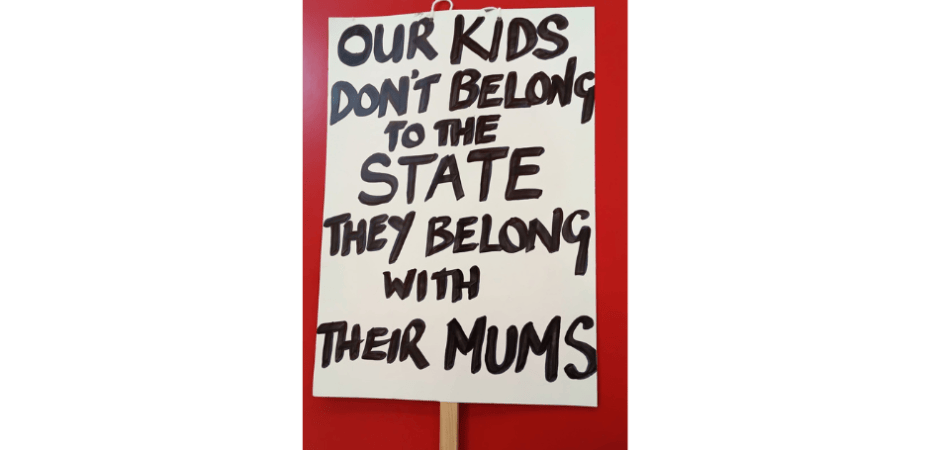
Sally has three children, two were taken into care but are now adults living at home with her. Her youngest child was adopted. She was a victim of severe domestic violence but instead of getting help and support to get away from the perpetrator, she was blamed and she and her children were punished by being separated. Her story is part of our forthcoming Dossier, After the Apology: the movement to stop today’s forced adoptions to be published during National Adoption Week (19-25 October). It includes testimonies from nine birth mothers, two grandmothers and two adult adoptees.
Fileon4 Investigates: forced adoption is it happening today? (6 October) is a result of the work we have done with the BBC over the past six months, putting them in touch with birth mothers (including Sally) whose children were forcibly adopted and with adoptees. The programme includes compelling interviews with those directly affected, as well as ourselves. We had written to Fileon4 after their earlier investigation, Adoption: the blame game (December 2025), pointing out that forced adoptions were not just “historic” and “to draw attention to the issues that lead to children being adopted in the first place . . .”. We invited them to get in touch.
Sally
Sally had two children and after she broke up from their father she got together with Simon. At first everything seemed fine and he love-bombed her but it turned out that he was drinking secretly and she later found out he was taking drugs. She confronted him about it because she didn’t want her children to be around alcohol and drugs, but by then she was pregnant. There was an incident where he pushed her over during an argument and her middle child witnessed it and thought she was badly hurt so ran outside screaming. A neighbour called the police and they made a referral to social services.
There were other incidents when Simon was violent: once the police arrested him but took him back to Sally’s house when they released him. She was isolated at home, he took her money so she couldn’t go out, she was too embarrassed to tell friends or family what was happening, her laptop, phone and the children’s phones were all smashed up and he just kept getting more violent. Repeatedly, when she called the police, they dropped him off near her house. He broke in several times and she was accused of letting him in. Social services started court proceedings to take the children away, and didn’t believe anything she said. They told the two older children that they’d be home in six months, but they never came back.
When she got a non-molestation order: “he breached it. I think it was seven times. He never got taken to prison, he got arrested a few times, but again, was usually kept in overnight and the next day he would be at my door kicking it in or climbing through windows, trying to break doors.”
Sally finally plucked up courage to press charges against Simon and went to court with a supportive police officer – although his evidence was never heard! Simon only got charged with criminal damage for kicking down her front door, the charges for his violence against her and the children were dropped. In fact, Simon alleged that she had been the perpetrator even though she had evidence of the bruises, etc., that he had caused. He got fined £500 and Sally then had to fight the Council who wanted her to pay for the damage to the door.
Sally was accused of “failing to protect” her children from domestic violence and the children were taken on the basis of “possible future emotional harm” because they said she was likely to get together with another violent man in future. They went back to investigate her childhood and the fact that her father had been violent to her mother was used to say she was “used to” these relationships.
“On the day of the court hearing the children were immediately removed straight after the court. They gave me about two minutes to say goodbye. They were with a friend. They actually dragged my middle child out of school. There were about seven social workers there when me and my mum got there. They dragged my youngest out of my arms and took all three.
Sally’s oldest child eventually went to live with her sister under a Special Guardianship order (he is now 24 and back at home). The middle child who has autism and ADHD went into foster care (where she went through 15 placements) and is now almost 18 and returning home. The youngest was placed for adoption during the first COVID lockdown. There were four remote hearings even though Sally asked to appear in court in person.
Sally appealed the placement and adoption orders for her youngest child, right up to the European Court of Human Rights, but the case kept getting referred back to the same judge who refused all appeals and ordered that the child be adopted. She was devastated when she found out that there was an “adoption party” at the court where the judge, social workers, CAFCASS, solicitors, adoptive parents and the child/ren attend to “celebrate” their adoption. “I just thought when I read it, I was just like, you know, how much more can you kick us in the teeth sort of thing, you know?”
Sally had been told the children would have post adoption sibling contact but as soon as her eldest came back home (two years after being taken into care) all that stopped. She now has letterbox contact only and is allowed to view one photo of her child each year – she is not allowed to keep a copy but has to go to social services’ office and look at it there.
Sally started by having contact with her middle child but was then told by a social worker that her daughter no longer wanted anything to do with her and didn’t want to be in her life.” So for five years she didn’t see her daughter. After a new social worker was appointed contact was reinstated and they speak on the phone every day, but Sally knows that her daughter now has serious mental health issues, “I’m a mum and I will fight to the end and I’ll fight for getting her help. I’ve been crying out, why hasn’t she had this counselling? Why hasn’t she had this help?”
“We’ve got a new social worker. I think she came in last year. I can’t remember. And I never thought that I’d say this about social workers. I mean, we’ve had five already. I think she’s the sixth one. But I don’t think I’d be getting my daughter home if I didn’t have this one . . . The system, you know, it damages, it damages more than it does good.”

