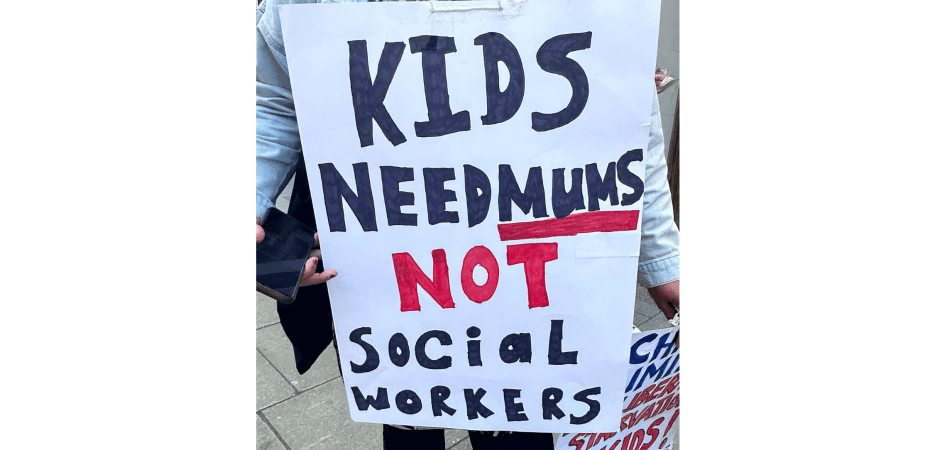
With little public notice Social Work England called a review to comment on how it is “discharging its statutory functions and delivering against the objectives” set out in the Children and Social Work Act 2017:
# promote and maintain proper professional standards for social workers in England
# to protect, promote and maintain the health, safety and wellbeing of the public
# promote and maintain public confidence in social workers in England
Below is our response.
Question 3:To what extent do you think Social Work England is achieving its core objective to protect, promote and maintain the health, safety and well-being of the public
Not at all
Question 4 Briefly explain the reasons for your selection above. Please provide any evidence (including any supporting weblinks) to support your view.
Children’s social workers routinely ignore/dismiss the needs of mothers/children in favour of an increasingly punitive child removal industry based on prejudice, profit and parental blame. (see also Question 8). Councils (and the social workers they employ) prioritise spending millions on institutionalising children rather than making resources available under Section 17 Children Act to support mothers so children can stay safely with their families. Since 2015 spending on removing children has increased by 30% to £9bn, whilst spending on keeping families together has been cut by 50% to £2.2bn. Social work teams have the power to act differently but choose not to.
By identifying more children as‘at risk’, , children’s social care drives its own demand. Too many children are needlessly taken through “child protection” – investigations were up by 127% in the past 11 years, while the number that did not result in a “child protection plan” (unwarranted) was up by 211% over the same period.
Unlike mothers who are constantly investigated and blamed, social workers have near-total impunity. Protective mothers who raise concerns find themselves targeted further and councils invariably defend their employees from criticism. Social workers show no interest in or compassion for the trauma children experience when taken from mothers/families. They dismiss the mother/child bond despite evidence of lifelong harm. This is compounded when siblings are split up, and when children are placed out-of-area – often long distances from families, schools and friends; many children face multiple (up to 12) changes of placement during their lives. Residential providers set up homes in poorer areas where housing is low cost in order to maximise their profits and social workers don’t object to the environment they are sending children into.
Supporting children to stay with their mothers instead of removing them would greatly improve children’s lives as the disastrous outcomes for care leavers show: over 10 times more likely than their peers to not be in education, employment or training (NEET) by age 21; 50% will be in the criminal justice system by 21; 25% will end up in prison; 50% have mental distress; 70% die prematurely and are 20 times more likely to die by age 25. Clearly ‘the corporate parent’, including social workers, are not doing a good enough job of protective children – why is this not taken into account when deciding to remove them?
Social workers show little or no concern for the shocking number of children have “gone missing” or died while in “care”. Government statistics say: of 12,430 missing incidents, 56% were from semi-independent accommodation, children’s homes or secure units, 25% from foster care. SWE must ask: how can children escape from secure units? And worse, how can 450 children die in care and no social worker is held accountable? This points to social workers protecting their jobs rather than the children they are responsible for.
Question 5: To what extent do you think Social Work England is achieving its core objective to promote and maintain public confidence in the social work profession?
Not at all
Question 6: Briefly explain the reasons for your selection above. Please provide any evidence (including any supporting weblinks) to support your view.
The public has very little confidence in the social work profession because time and again TOO MANY UNJUSTIFIED INTERVENTIONS are made, causing distress and worse to children and families, while at the same time, interventions are NOT made when they should be, often with tragic consequences. The reason for this is a sexist disregard for mothers often in favour of fathers. Repeated child death safeguarding reviews make recommendations; social workers say “lessons are learned” but policy and practise do not fundamentally change.
To restore public confidence, SWE must ensure that social workers:
- Stop taking children from mothers who love them, breaking the unique bond between mother and child (which begins in the womb), causing life-long trauma.
- Listen to children rather than dismiss what they are saying when it contradicts what social workers want.
- Ensure that the importance of the mother-child bond is part of social workers’ training, so that the trauma of separation is not dismissed when decision are made on whether children should be taken into care, too often followed, especially for babies, by forced adoption.
- Follow the lead set by Dr Andy Bilson in the 1970s which showed that when social workers were allocated money to help families rather than to take children into “care” – up to 70% fewer children were taken. This is also true in Neath Port Talbot which is prioritising support successfully and significantly reducing children in “care”.
- Stop placing children under Deprivation of Liberty (DoLs) in accommodation run by private providers whose primary motivation is profit (83% of children’s homes are run for profit) including caravans and narrow boats. DoLs have risen by 462% since 2023. See Nuffield Family Justice Observatory (NFJO) which found increasing numbers of children put before the High Court to be considered for unregistered placements where they would be subject
to deprivation of liberty, not because of need but because of a lack of regulated placements available. - Stop prioritising forced adoption over support to families. Research shows that 1/3 of adoptions fail completely and a further 1/3 are broken down and traumatic. Instead, there should be much greater use of kinship carers who should be paid on the same basis as foster carers.
- Prioritise reunification of children in “care” instead of punitive measures such as reducing mothers’ contact on spurious grounds, resulting in infrequent contact (3-6 times a year), making it harder to maintain a close relationship with children and reducing the chances of ever being reunited.
- Question 7: To what extent do you think Social Work England is achieving its core objective to promote and maintain proper professional standards
- Not at all
Question 8: Briefly explain the reasons for your selection above. Please provide any evidence (including any supporting weblinks) to support your view.
Based on mothers’ experience attending Child In Need, Child Protection conferences and LAC reviews, SWE does not maintain proper professional standards. This is confirmed by LGSCO which reports consistently high rates of upholding complaints, 91% for children’s services (2024-2025). This shows that many concerns raised by mothers are valid and reflects systemic problems with children’s social services including bias especially against single mothers and other discrimination, significant delays and poor communication.
When mothers raise concerns through the official complaints system, they are punished, often accused of ‘not able to work with professionals’ which is a given reason for taking children even though it is not part of any legislation. The system is further abused as paperwork proving mothers’ points conveniently goes missing. Or worse, when SARs requests are made, there is evidence of social work managers changing junior social workers’ reports for court from positive to negative to enable taking or keeping children in “care” or having them forcibly adopted. Social workers write woefully inaccurate and misleading reports yet when a mother asks for corrections she is ignored. These inaccurate reports go into court and are taken as statements of fact
to influence the court’s decisions to remove children.
Mothers in CIN and CP meetings report being shouted at, bullied, ignored, over-ridden and/or given false or misleading information by social workers, who have wrongly claimed to know the law in order to silence a mother. If a mother has an independent advocate who challenges what social workers are saying, they try to have the advocate banned from meetings and become hostile rather than apologetic.
Social workers who behave in a criminal manner and perjure themselves in court are protected by family court and SWE and maintain their jobs despite their own personal behaviour. Despite social workers being named by a judge SWE protects them. It is deeply shocking that in all the cases of child deaths subject to Child Safeguarding Practice Review Panel, children were known to social workers and despite numerous death inquiries, social workers are still ignoring the children who need help in favour of targeting mothers who need support. Sara Sharif, Arthur Labinjo-Hughes, Leiland-James Corkill are a few of many deaths where social workers either ignored or dismissed obvious signs of abuse and left children to suffer, their lives in danger. The same social workers treat innocent mothers with appalling suspicion, blame and judgement resulting in their children being taken. Children are dying in care homes while social workers stand by. Approximately 1,000 children ‘in need’ die each year, a much higher risk than the general child population while 40 to 60 looked after children die every year, all apparently under the watchful eye of social workers, who are rarely held accountable.
Section 3 – Equalities Act
Question 9: How well do you think Social Work England delivers its responsibilities under the Equalities Act to ensure no one is discriminated against based on their protected characteristics? Please provide examples and any supporting evidence.
SWE completely fails to deliver its responsibilities under the Equalities Act. Disabled mothers, domestic abuse victims, single mothers, care leavers, women of colour, immigrant women, sex workers, are often considered by social workers to be unfit mothers. When mothers ask for state support which they are legally entitled to, they are blamed for needing that support. Poverty is not neglect, but it is used to imply neglect and remove children.
Children of colour are targeted: research shows they are more likely to be on a Child in Need, Child Protection Plan or be in “care”. Children living in the poorest areas are 10 times more likely to be taken into care. In England,children of colour are most likely to remain in institutions mostly run by private companies. This goes against the welfare of the child since children in care homes were nearly four times as likely to have experienced child sexual abuse.
Our submission to the Law Commission documents how disabled mothers/disabled children are not supported and are routinely denied legal rights and subjected to harmful child protection/family court proceeding where social workers, without medical training, make biased judgements on needs. Instead of supporting families under S17, mothers are accused of Fabricated Induced Illness (FII) which is opinion-based junk science. Social workers use false terminology that they have made up, like ‘substitute parenting’, which lack any evidence. Both are discriminatory.
Our work with Channel 5 found that, shockingly, parents with a learning disability are 54 times more likely to have their children taken into care confirming the discrimination and hostility faced by disabled mothers, and other single, of colour and working class mothers who face an uphill battle to stop social workers taking our children.Councils claim they can’t afford the support mothers are entitled to, yet pay private companies’ obscene amounts, such as £1m a year to place one disabled child in institutions like Hesley Group where rape and abuse are rife. Thousands of children who were raped and abused at Shirley Oaks and in Rotherham were in state care, and nothing happened to the social workers and police who allowed, enabled or took part in the abuse.
Being disabled, a victim of domestic violence (which disproportionately affects disabled women), a single mother on a low income, young or having grown up in care, are regularly flagged up as a “safeguarding issue”. Mothers are referred to social services and come up against preconceived ideas and prejudices thinly disguised as concern for their children.
Mothers are being tortured by the constant threat of removal by social workers, knowing how vulnerable our children are, and the devastation and trauma they will face if they are taken. Yet, the impact of this separation and the mother/child bond is hardly ever considered. As a result, mothers are often too afraid to ask for help.
If you have any additional comments, evidence or suggestions that you have not had the opportunity to provide elsewhere, please do so here.
The Support Not Separation Coalition (co-ordinated by Legal Action for Women) started in 2017 to defend mothers and children against unwarranted separation and the devaluing of the mother-child relationship. The Disabled Mothers’ Rights Campaign (DMRC, co-ordinated by WinVisible – women with visible and invisible disabilities) brings disabled mothers together to defend our right to have and to keep our children.
Children’s social workers have the backing of state power in relation to families’ lives in which they can make draconian interventions. With little public scrutiny or accountability, they are able to abuse that power by making judgements about mothers which holds us to a much higher standard than is reasonable, and much higher than the “corporate parent” is ever held to.
When disabled women with children ask for Care Act support they are entitled to, adult social workers should assess them under Section 12 and provide family support. Invariably however they report to children’s services who are likely to treat the mother as being unable to cope, or see her disability as harmful and she is pushed onto child protection often leading to removal through family court.
50% of FII (Fabricated or Induced Illness) allegations come after a mother complains about lack of support and disabled mothers are four times more likely to be accused.
Mothers report widespread sympathy for fathers among social workers who promote contact even when the father has been violent to the mother, and in some cases, to the child.
Mothers who are women of colour reportracist treatment by social workers – for example refusing to shake their hand; criticising feeding a child by hand and lacking any regard to cultural difference or a child’s first language, not maintained once in care – this has led to children’s deaths.
We strongly oppose The Children’s Wellbeing and Schools Bill which would give social workers even greater powers to deny parental choices of education and medical treatment without any independent regulation. It would extend the ‘corporate parent’ by bringing in more professionals and introduce a “consistent identifier”, treating all children as numbers, who belong to the state and not their families.
We share the concerns of Professor Ray Jones that the Bill would create more child protection social workers which would be even more threatening for families, and would lead to even more children being taken into care. Mothers have experienced social workers saying one thing to them in person but filing something entirely different in their reports.
Children’s Minister Josh MacAlister set up Frontline, a fast-track training programme for ‘child protection’ social workers with the emphasis on Signs of Safety practice model focused on child protection rather than family support for children in need, ignoring increasing and severe poverty. MacAlister’s role in supporting this Bill must be a conflict of interest which should be investigated.

