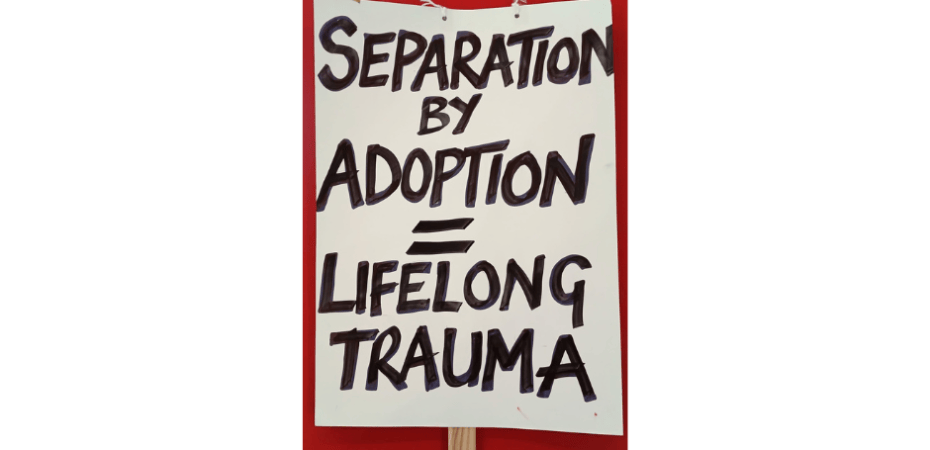
Jane has four children, two of whom have been adopted, one is with their father and the youngest lives with her. Jane is autistic and has the support of her mum. Their stories are part of our forthcoming Dossier, After the Apology: the movement to stop today’s forced adoptions to be published during National Adoption Week (19-25 October). It includes testimonies from nine birth mothers, two grandmothers and two adult adoptees.
Fileon4 Investigates: forced adoption is it happening today (6 October) is a result of the work we have done with the BBC over the past six months, putting them in touch with birth mothers (including Jane) whose children were forcibly adopted and with adoptees. The programme includes compelling interviews with those directly affected, as well as ourselves. We had written to Fileon4 after their earlier investigation, Adoption: the blame game (December 2025), pointing out that forced adoptions were not just “historic” and “to draw attention to the issues that lead to children being adopted in the first place . . .”. We invited them to get in touch.
Jane
When Jane was pregnant with her first child, she told the midwife that she is autistic and suffers from fibromyalgia, so they made a referral to social services. Initially she had a social worker who was supportive, but a new one took over who was not, and started going to Jane’s home with an “assessor” insisting on asking her lots of questions. Jane struggled to answer so many questions as her one-month-old baby was crying and asked them to come back when her mum or partner could take the baby. They said, “Oh so you can’t multi-task, so you can’t look after a baby and listen at the same time”, and then said, “Oh so you need someone else to have your baby for you.” Jane was understandably upset and asked them to leave. They only did so after she threatened to call the police. From then on, they went to her home regularly, banging on the door, to the point where she was too afraid to answer.
Social workers decided to put Jane’s daughter on child protection and subsequently they regularly made unannounced visits and accused Jane of being “unable to keep her emotions stable” and “not really caring about [your] daughter”. The way they spoke to Jane made her incredibly anxious and she found their visits very stressful.
When her first child was 11 months, she had another baby and she and the two children were sent to an adult foster placement where she was made to cook outside in a shed in the garden and bring the food into the conservatory to eat. When she complained about the conditions through her solicitor, the foster carer became very aggressive, took her phone and deleted the photos of the shed that she’d taken and became violent. Jane left the placement but was not allowed to take the children with her and court proceedings began. Jane passed a Parenting Assessment Manual (PAM) Assessment but the social worker said that she “lacked the capacity to change emotionally” and therefore the children should not live with her.
One of the things used against Jane was that she had an abortion after becoming pregnant during the family court proceedings because she did not want to bring another child into it. They said that this was an “immature” decision although the judge said this should not have been raised and said “if the mum can think of a plan to do what’s needed to get the children back into her care by the next court case, then I’d be open to looking at that”. Tragically, the next court case was allocated to a different judge who only had time to go through social services’ previous evidence and didn’t even look at Jane’s evidence – within about five minutes in court the judge made the order for adoption. Jane wanted to appeal but could not find a lawyer to help. She has letterbox contact with the two children.
When Jane became pregnant with her third child social services used the “evidence” from what had happened with her first two children to claim that she would be unable to look after him. He was taken after being with her for nine days in hospital (she was recovering from a blood clot in her leg caused by stress). The baby was given to his father who was told that if he didn’t take him, he would be adopted. Jane felt she had no choice but to agree.
When Jane became pregnant again, she insisted on having a social worker from another area and was allocated someone who did not use her autism against her and was generally supportive. But she was told that she could only keep her daughter if she agreed that the social workers had been right to take her children and that she understood why they did. Another condition was that she had to take down all the photos of her other children in her home. Jane had no choice but to agree if she wanted to keep her daughter, who is now a lively toddler and thriving. After six months she was signed off Child in Need and has had no further involvement with social services.
After the children were adopted, Jane went to PAUSE for support. She was told that a condition for their support was that she would have to take contraception for seven years and also would not get support if she had children living with her. Her social worker then referred her to WORTH and they were very helpful.
“It’s very painful because when my last child was born, obviously I couldn’t let my emotions show, I couldn’t cry, I had to keep everything in, I had to show that I had no emotional attachment anymore to my other children, I had to fake it in a way. Even though I had emotional attachment to my other kids, I could not show it. I had to keep it in. It’s been exhausting. And it was really hard because when she was born, she looked exactly like my first. She had the same face, the same features, the same blue eyes, the same hair, the same everything. And she even weighed around the same. and even now people say they look like twins it’s just one’s got blonde hair one’s got brown hair that’s the only difference.”
Jane’s mum, Mary
“We met the first foster carer and she seemed very nice. She told us she understood autism but after two days she told social services that she couldn’t work with Jane, she didn’t understand how to help her.
For the next foster placement Jane was moved out of our area. I wasn’t allowed to know where she was, or where my grandchildren were, even though I am the main support for Jane. I did meet the foster carer once in town and she told me, ‘your daughter is so rude‘. I tried to tell her that Jane is autistic and she’s very straightforward and takes thing literally, she was not being deliberately rude. Once Jane was out of their area, social services did not provide continuation of her peri-natal counselling, which she had found really helpful.
The place where Jane had to stay was an outhouse-come-shed. It was like a wooden shack and it wasn’t very nice at all. On the other hand, the foster carer’s house was amazing! They must have spent bucketloads on improvements. Jane slept in the shed but the children slept in the house and if one of them woke up (keep in mind the baby was just two or three months old), the foster carer had to call Jane to go in to see them. It’s no wonder Jane couldn’t manage living like that, with a toddler and a newborn.
In all the involvement with social services there was a complete lack of understanding of how to work with my daughter and the fact that they just didn’t want to provide any support for her other than what I could give her. There’s a lot of exaggeration in their threshold reports. For example, there’s a paper clip on the floor, and they say that’s a choking hazard. There was a phone charger on the floor, so therefore that’s a risk of strangulation and death! I really feel like children’s services over exaggerated everything and used the fact that Jane has physical health problems and autism to literally make it sound as if she couldn’t parent, you know, a teddy bear. Yet her fourth child, Renai, is thriving [with Jane]. She really is.”

